
Start a Norton County Property Search
Start with whatever fact you already hold. A street address belongs with the Appraiser and ORKA. An owner name or a transfer question belongs with the Register of Deeds. GIS adds map context, and the Treasurer handles any bill or payment question. Norton County states that its real-estate records are not available online. That limitation comes through the Register of Deeds. That makes a complete legal description valuable. It can tie a modern assessment to an older deed-book entry and a recorded plat.
Every record has limits. The assessment roll supports tax administration. A recorded deed names the parties and the land description in a transfer. A mapped parcel line is a reference, not a survey. Compare the name, date, and legal description before treating two results as the same tract.
- Enter the address in ORKA and select Norton County.
- Save the owner spelling, parcel reference, and full legal description.
- Ask the Register of Deeds to check both index directions for the names and years involved.
- Confirm tax facts with the Treasurer and compare the tract with GIS or a recorded plat.
- Order the instrument or court filing when an index entry matters to the result.
The Norton County property search lays out the field-by-field route in full. Keep a search log as you go. Note spellings, date ranges, book and page references, and the source of each fact.
Where Norton County Keeps Records
Three offices at the Norton County courthouse handle the core work. The Register of Deeds keeps deed records and other instruments. The Appraiser classifies and values each parcel. The Treasurer bills and collects the tax on it. All three sit on the second floor at 105 S Kansas Avenue, open weekdays from 8 a.m. to noon and 1 to 5 p.m.
Norton County Register of Deeds
105 S Kansas Avenue, second floor
Norton, KS 67654
785-877-5765
Norton County Appraiser
105 S Kansas Avenue, second floor
Norton, KS 67654
785-877-5700
Norton County Treasurer
105 S Kansas Avenue, second floor
Norton, KS 67654
785-877-5795
Norton Deeds Stay Offline
Real-estate records stay offline in Norton County, according to the Register of Deeds. For a records request, supply the grantor or grantee. Add a date range, instrument type, and legal description. Include any book, page, or document number you know. The county genealogy guide recommends a ten-year range when searching an ancestor's name. Kansas law requires both direct and inverted indexes. A chain of title should be checked in both directions.
The holdings run wide. They include deeds, mortgages, oil and gas leases, easements, surveys, water rights, city-addition plats, liens, powers of attorney, and some UCC filings. The genealogy guide lists an $18 hourly search charge paid in advance plus $1 copies. Totals should be confirmed before sending payment. Sales Validation Questionnaires and military discharges are not open like ordinary deeds. The official deed office page confirms the local access route.
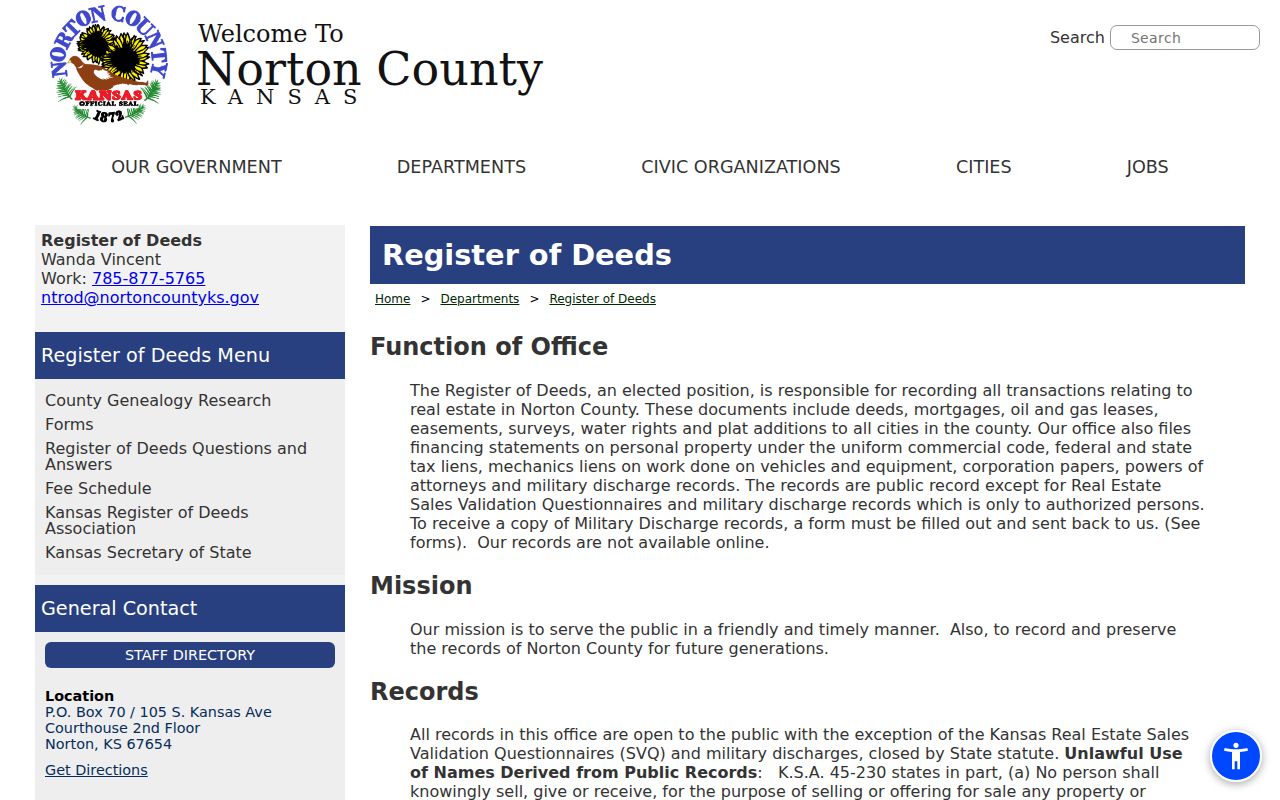
The Norton County recorder's office page is a starting point for deed research. The recorded instrument itself remains the source for the exact terms of any Norton County deed.
Norton Assessment Records Use January
Every January 1, the Norton County Appraiser sets fair-market value for assessable property. That appraisal covers the whole county. Sales, construction costs, and rent data feed that appraisal work. Construction only partly finished gets valued by how complete it stands on that date. Agricultural land works differently. It leans on productivity and statutory formulas rather than the usual willing-buyer, willing-seller test. The Appraiser page is the official route to the office and to ORKA. The county also posts time-trend notices covering 2023 through 2026. Keep in mind that none of this converts an assessed value into a sale appraisal. The county's educational formula multiplies purchase price, assessment rate, and mill rate. Yet a real tax bill has to draw on current parcel and taxing-district data.
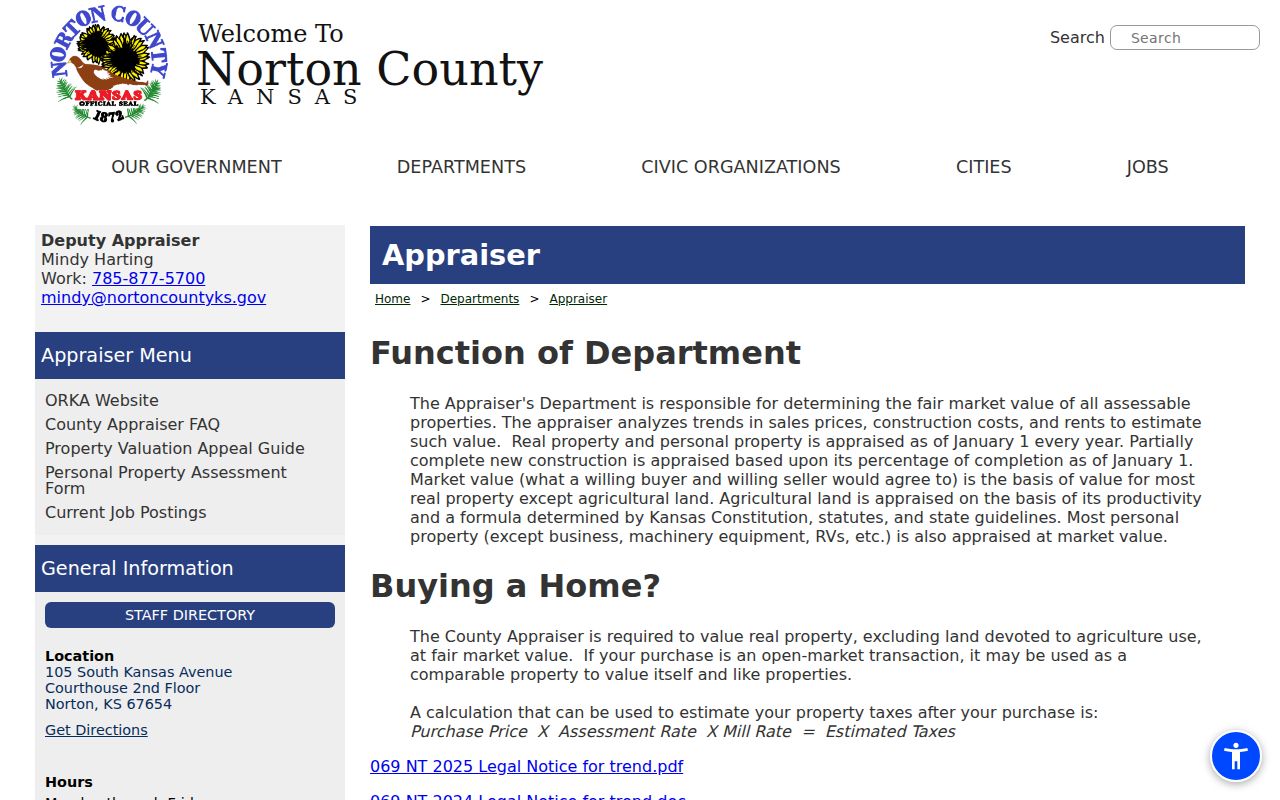
The page names the custodian to contact whenever an online property result is missing or unclear.
Norton County Maps Need Context
ORKA is the statewide property and GIS starting point, and the Appraiser links to it. The county publishes no Norton-specific sample parcel card or documented parcel-number format. A separate Norton County ArcGIS service does display addresses, roads, emergency-service zones, and municipal boundaries. It shows no confirmed parcel-owner layer, though. Mapped features can orient a search without proving ownership or fixing a boundary.
A recorded plat often helps more when a deed cites an addition, lot, and block. Request the plat from the Register of Deeds. Then reconcile it with the current assessment description. For rural land, keep the section-township-range wording exactly intact.
- Parcel
- A unit tracked for assessment and mapping.
- Plat
- A recorded drawing dividing land into lots, blocks, streets, or tracts.
- Situs
- The physical property location, which can differ from the owner's mail address.
- Assessed value
- A tax-system value, not a guaranteed selling price.
Norton County Property Record Types
No single Norton County property record answers every question. Match the source to the fact, then compare names, dates, and land descriptions across results.
| Record Type | What It Documents | Kept By | Access |
|---|---|---|---|
| Deeds and easements | Transfers, parties, land descriptions, reserved rights | Register of Deeds | Office index and copy request |
| Mortgages and liens | Recorded claims, releases, and encumbrances | Register of Deeds | Direct and inverted office indexes |
| Assessment and tax | Class, annual value, taxing data, payment | Appraiser, Clerk, Treasurer | ORKA, office, mail, state payment route |
| Plats and mapped layers | Lots, blocks, roads, addresses, city limits | Register of Deeds and GIS | Recorded plat, ORKA, ArcGIS service |
| Property court files | Foreclosure, quiet title, probate, partition | District Court Clerk | Portal, courthouse terminal, copy request |
A deed documents a transfer. Assessment data explains public valuation. Tax records track collection, and plats interpret a legal description. A court order can change a land interest, so use the original source whenever the distinction matters.
Norton Court Records Affect Property
Norton County District Court sits within the 17th Judicial District. Property research usually narrows to civil, limited civil, or probate matters. Those cases often involve foreclosure, quiet title, partition, liens, an estate, or sale terms. A name match is only a lead. Confirm the case number, caption, filing, and parcel description before relying on it.
The courthouse offers a free public terminal. Printed pages cost 25 cents. Certification runs $1 per document. Larger requests may add a $5 research fee. Requests are accepted in person, by mail, or by fax. The clerk responds within three business days with a cost or timing update. The Kansas Courts portal adds remote access under statewide rules.
Norton Land Records Begin in 1874
Norton County was established in 1867 and organized in 1872. Its land records begin a bit later, in 1874. The county seat wandered from Leota and back. Norton won the fight for good in 1878. Early deeds rarely look like modern addresses. Instead, they lean on townsite, addition, lot, block, or rural descriptions. These can puzzle a first-time reader.
Local holdings help fill the gaps. The Norton Public Library genealogy room and the Norton County Genealogical Society keep newspapers, census microfilm, county histories, obituaries, cemetery materials, and rural-school records. They also keep the 1917 Standard Atlas. That atlas packs in landowner maps, city maps, portraits, and biographies. Society research runs $25 for the first hour, and appointments are available. The 1917 atlas resource can yield an earlier owner or a place clue.
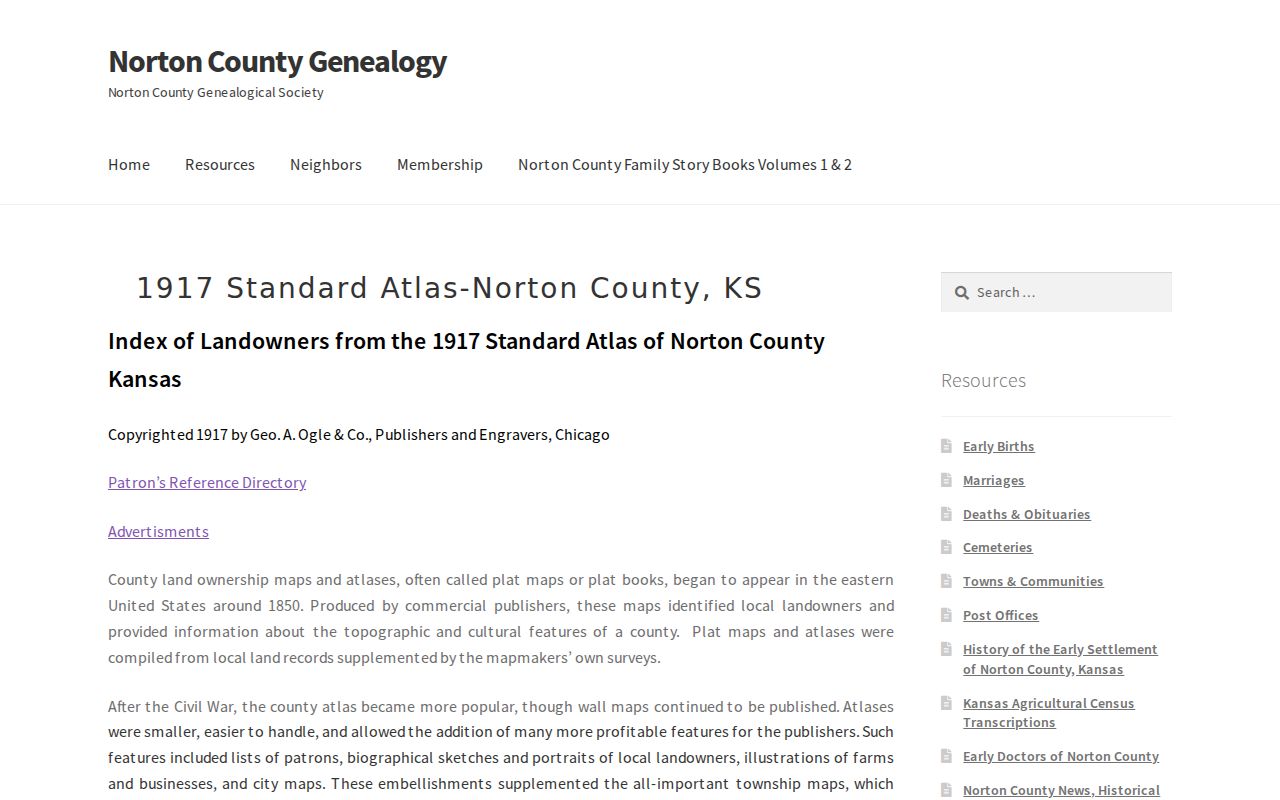
An atlas clue only becomes part of a title chain after it is checked against the deed books.
Norton Municipal Files Add Detail
Norton County itself runs no county zoning program. Inside the City of Norton, though, municipal records matter. They can carry real weight for a property search. Permits, zoning actions, code enforcement, council decisions, and cemetery matters all pass through city channels. The code inspector takes building applications and handles complaints keyed to an address. One caution applies. The city's 2020 code may lag behind newer ordinances. Current questions should go straight to city staff.
Almena takes a different route. Its official page tells permit applicants to download a form. They can return it for council discussion at the first Monday meeting of each month. Exact fees, fields, and inspection timing come from the city itself. Lenora publishes no comparable online permit lookup.
Norton Tax Records Cross Offices
The Treasurer collects taxes for the state, the county, cities, schools, and every other local district. The office then distributes the money. Payment can be simple. A check or money order works through the west-side courthouse drop box or by mail. The county also links the state payment portal for online payers. For history, there is no free Norton tax-bill or delinquency search screen online.
The County Clerk balances the other half of the tax record. That office finalizes assessed values and adds special assessments once October levies are set. It also prepares the tax rolls and statements. When the web route fails to show the year you need, contact the Treasurer with a parcel number or legal description. Include the tax year in question.
Norton Open Records Requests
Kansas offers a fallback when a Norton County record is not posted online. The Kansas Open Records Act, K.S.A. 45-215 et seq., gives any requester a path to it. You do not have to live in Kansas. Once a request arrives, K.S.A. 45-218 requires the agency to act by the end of the third business day. That deadline cannot always be met. Staff must then explain the delay and give a reasonable time for a full response. They are not obliged to build a new record or research a question for you.
A well-built request moves faster. Name the custodian, the address or legal description, the date range, and the record type. Also name the format you want, whether that is a deed record, a parcel file, or a plat copy. Ask for a cost estimate first. Staff time, copying, redaction, and media charges can require advance payment. Closed material stays closed even when it sits beside public information.
Norton Addresses Need Cross-Checks
An address opens doors in Norton County property records, but it is not the legal identity of the land. Norton's city code ties address numbering to an official map and master plat. Even and odd numbers sit on opposite sides of a street, with State Street and First Avenue as reference lines. Rural properties lean on road names, emergency addressing, and township-range descriptions instead. ZIP codes add yet another wrinkle. Norton uses 67654, Almena uses 67622, and Lenora uses 67645, yet a postal label says nothing about a municipal boundary or which office controls a permit.
Keep four fields straight in any property search. The situs address is where the land sits. The mailing address is where notices go. The parcel number is an assessment key. The legal description is the recorded identity of the tract itself. A mismatch is not always a mistake. A farm owner may get mail in another town, a trust may list a representative, and an older deed may describe land with no street number at all.
If ORKA rejects the exact wording, try a normalized street form first, then ask the Appraiser to link the address to the legal description. For land in Norton, Almena, or Lenora, confirm the municipal boundary before chasing permits. The county runs no zoning program, so city limits decide whether a planning or code file exists at all. For a subdivision parcel, keep the addition name, lot, and block exactly as written. For rural acreage, keep every section, township, range, quarter, and exception. These small distinctions keep one tract's deed records from drifting onto a neighbor with a similar address.
Address clues also surface outside the land offices. City council minutes can record street work, vacations, zoning action, or a permit dispute. County commission papers cover roads, county-owned real estate, contracts, and public projects. Newspapers can tie an old place name to a family, sale notice, or legal description. Each source adds context, but none replaces the deed, plat, assessment, or court order that proves the fact.
A smart request names the smallest useful record set. Ask for a permit at a stated address, a board action within a date range, or a deed index search for named parties. Do not ask an office to find everything about a person. Narrow terms cut staff research time, sharpen fee estimates, and help the custodian pull an existing record instead of building a new report. Include a phone number or email for the cost notice, and say early whether an uncertified scan will do. If certified proof is required, say so at the start. Save the response with the request so later readers see which years and files the custodian searched. That scope matters most when a search comes back empty.
Limits of Norton County Records
Norton County property records can carry you far. They name an assessment owner, document a conveyance, and reveal a lien. They supply tax data, and they place an address on public map layers. They cannot prove who lives there. Mailing and situs addresses often differ. An LLC, trust, or estate may hold title. A recent deed can also be newer than the assessment roll.
Kansas Safe at Home gives qualifying victims a substitute address with mail forwarding. Never infer residence from a public mailing field. Compare official sources instead. Even the best index can hold a spelling variant. It may also lack the image needed to read an entry.
Lawful use. Use these records for land research, purchase diligence, estates, boundary questions, and civic transparency. A lookup is not a title search or survey, and owner data must never be used to stalk, harass, intimidate, or harm anyone.