
What Norton County Deed Records Put on Paper
The Norton County Register of Deeds puts each land transfer on the record. A deed names the parties, describes the tract, and preserves the recording reference. It does not cure every title defect by itself. Alongside deeds, the office records mortgages, oil and gas leases, easements, surveys, water rights, plats, tax liens, mechanics' liens, powers of attorney, and UCC filings.
| Deed Type | What It Does | Common Use |
|---|---|---|
| Warranty deed | Conveys the described interest with stated covenants | Ordinary arms-length transfer |
| Quitclaim deed | Conveys whatever interest the grantor has | Interest cleanup or family transfer |
| Executor or trustee deed | Conveys through fiduciary authority | Estate or trust administration |
| Sheriff's deed | Follows a court-authorized sale | Foreclosure execution |
| Tax deed | Documents a completed statutory tax process | Delinquent-tax transfer |
A mortgage or lien burdens an interest rather than conveying it. A deed transfers; a lien encumbers. Always chase the later release or satisfaction, because the first filing alone cannot show whether an obligation is still open.
Norton County Keeps the Deed Search Offline
Real-estate records in Norton County are not available online. Every deed request runs through the Register of Deeds office. Call, visit, or mail it. Provide grantor and grantee name variants, the document type, and the legal description. Add a bounded date range. The office sits in the Norton County Courthouse at 105 South Kansas Avenue. Its official page posts current hours and contact details. Preparation pays. Pull the legal description through the property search. Separate the situs address from the mailing address. Keep every addition or land-grid term intact. Staff time spent untangling a vague name buys less than a request tied to one tract. The county's official page confirms the recorder channel.
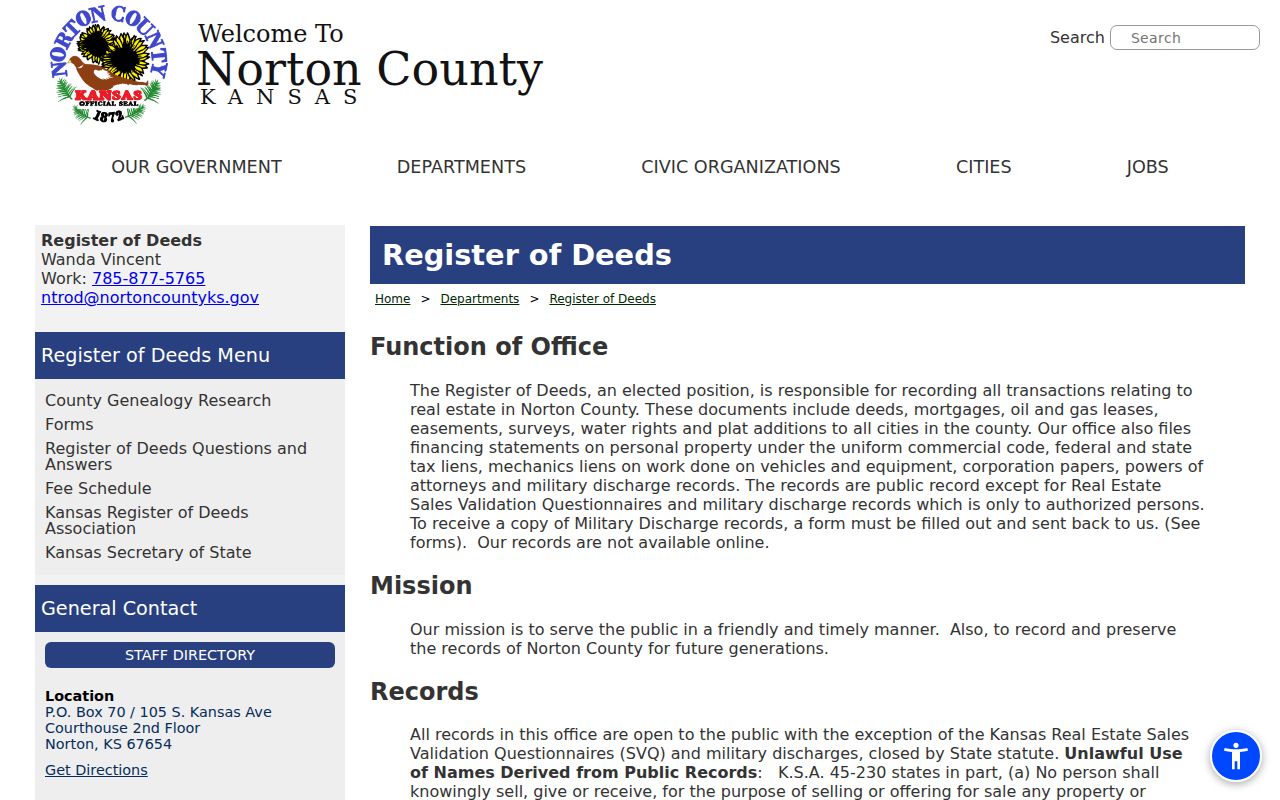
Use that official page to verify access and fees before ordering.
The Land-Record Trail Begins in 1874
Norton County land records begin in 1874, according to the county's own genealogy research guide. The guide points to receiver's receipts, patents, deeds, leases, and homestead files. Older deed records live in books, indexes, and local finding aids. No web image search replaces them. The Norton Public Library genealogy room and the Norton County Genealogical Society extend the trail. Their holdings include atlases, newspapers, cemetery sources, and local compilations. Historic names matter too. The county carried the Billings name briefly in 1873. Norton was restored in 1874. Early references may sit under either name. That is a search aid, not proof that the land changed counties.
Additions and Rural Sections Need Different Deed Keys
Platted city land usually appears as addition, lot, and block. In Norton County, Rogers' 1878 plat shows the pattern. The Norton Town Association filed and refiled in 1878 and 1886. A parcel may need both the original and later plat references. Spencer's, Howard's, and Hillside additions are concrete local examples. Rural deeds work differently. They cite section, township, range, a quarter section, and acreage. A 2024 sheriff-sale notice shows both styles at once. Separate each tract. Copy punctuation exactly. Ask for the plat whenever a deed leans on an addition name.
Note: A street address is only a discovery clue. The full recorded legal description controls the deed request.
Read Norton County's Direct and Inverted Indexes
K.S.A. 19-1205 directs the Norton County recorder to keep both direct and inverted indexes. The two-sided setup means a deed records search can trace either party. It can follow the grantor. It can also follow the grantee. Either way, anchor the chain of title to the parcel's legal land description. Do not anchor it to a surname.
- Locate the current acquiring deed with the current owner as grantee.
- Read the named grantor and confirm the legal description matches.
- Search that grantor as an earlier grantee and repeat the comparison.
- Record dates, deed types, and book/page or instrument references in a timeline.
- Grantor
- The party conveying an interest.
- Grantee
- The party receiving it.
- Chain of title
- The ordered sequence of instruments affecting one tract.
- Book/page or instrument number
- The retrieval reference assigned to a recorded filing.
Restricted Questionnaires Are Not Missing Deeds
A Sales Validation Questionnaire often accompanies a Kansas transfer. Norton County treats those questionnaires as confidential. K.S.A. 79-1437c and 79-1437f impose the requirement and narrow access. The deed stays on the public record. The questionnaire behind it does not. Military discharges get similar restricted handling. Never infer a sales price or call the index incomplete because the form cannot be inspected; use the Appraiser's published assessment material for valuation context and request the deed itself as proof of the transfer.
Fees Require a Current Office Check
Fees shift, so confirm before paying. The local genealogy guide quotes research at $18 per hour and copies at $1 per page. The county fee sheet is dated July 1, 2014. Kansas sets recording fees by statute, K.S.A. 28-115. Those sources are not interchangeable. Describe the document and whether you need certification, ask for the present amount, and wait for an estimate before sending payment. Plain copies serve reading, certification makes a copy official, and neither turns the recorder's index into a title opinion.
Search Beyond the Deed for the Complete Recorded Interest
A deed chain shows who conveyed to whom. It rarely shows the rest. Mortgages, easements, oil and gas leases, water rights, mechanics' liens, tax liens, and powers of attorney can all affect a Norton County tract. Search those instrument categories using the same legal description and party variants you already gathered. Every mortgage or lien deserves a second look. Later in time, hunt for a release, satisfaction, assignment, or court disposition. Record both documents in your log rather than treating the original filing as permanently open.
Court files explain what a deed cannot. Sheriff's deeds, probate transfers, partition, foreclosure, quiet title, and lien enforcement all leave a trail in Norton District Court. That court offers a public terminal at the courthouse plus a separate statewide portal, and copies are available by request. A court order may authorize a transfer, but the recorded deed shows what actually reached the Norton County land records. Read the two systems together.
For older tracts, newspapers and the 1917 atlas can surface names and description clues. Treat them as leads only. An ownership-era map, obituary, or legal notice still has to be reconciled with the direct and inverted deed indexes.
Note: Norton County publishes no property-fraud alert enrollment service; confirm suspicious deed mail directly with the Register.
Historic Collections Extend the Norton Deed Trail
A stalled deed chain is not a dead end. The Norton Public Library genealogy room and Norton County Genealogical Society resources can reopen it. Their collections span early births and marriages, obituaries, cemeteries, town histories, newspapers, maps, schools, courthouse sources, and bibliographies. Any one of these can supply the missing piece. A spelling variant may surface there. A family relationship, an old town name, or an approximate transfer period may surface there too.
Newspapers are a second channel. The Kansas Historical Society's newspaper catalog and digital collections carry legal notices from across the state. Search an addition name, a landowner, an estate, and the alternate Billings/Norton county wording. A published notice can point to probate, foreclosure, a tax sale, or a sheriff's action. It proves an event was announced, not conveyed. Use the lead to locate the District Court file and the deed recorded afterward.
Townsite history matters at the parcel level in Norton. Rogers' plat and the Norton Town Association refilings explain the discrepancy. They show why two sources can cite related but nonidentical townsite language. Request the plat cited by the instrument itself. A visually similar atlas page is no substitute. For rural property, historic owner maps help identify neighbors and a section. The section-township-range evidence must still be matched against the deed books.
Estate transfers can break a clean sale-to-sale chain. Search the decedent or the estate in District Court. Then identify the orders or fiduciary authority behind the transfer. Return to the Register for the deed or other instrument recorded under that authority. That split between the legal proceeding and the land-record filing explains the anomaly. It shows why an executor, trustee, or sheriff appears as grantor.
Request the Exact Norton County Deed Copy
Norton County offers no online image route. Request the deed at the counter, by telephone-guided procedure, or by mail. The office permits each of these. Be specific. Include the parties and an approximate recording date. Add the deed type and the legal description. Include any known book/page or instrument number. State whether a readable plain copy or certified copy is required. Also say where it should be delivered. One caution applies to atlas work. If the description came from a historic atlas, verify it against the later deed chain before ordering.
The 1917 Standard Atlas is a valuable ownership-era snapshot. It cannot replace the instrument sequence. A court sale notice shows an announced process rather than the completed deed that followed.
Recorded, not guaranteed. Norton County deed records show instruments accepted for recording. They do not resolve unrecorded claims, survey conflicts, probate issues, or every defect a professional title examination considers.