
Check Norton County Current Owner Fields
The Appraiser is the local starting office for a present owner check. The County Clerk FAQ directs a person with an address or legal description there. The Appraiser values property as of January 1 and links to ORKA. No static Norton parcel card was captured, so exact local field labels must be read from a live record rather than assumed.
| Owner of Record | Assessment name when exposed on the live card |
|---|---|
| Assessment Year | Date context for that owner lead |
| Mailing Address | Tax-notice destination, not proof of residence |
| Situs Address | The physical property location |
| Legal Description | The tract key used to match a deed |
| Deed Reference | Use only if the live Norton record verifies it |
An owner of record is simply the name an official roll carries at its stated date. It is not automatically the occupant, and it may hide every beneficial owner behind a trust. Consult the Norton County Appraiser before entering ORKA.
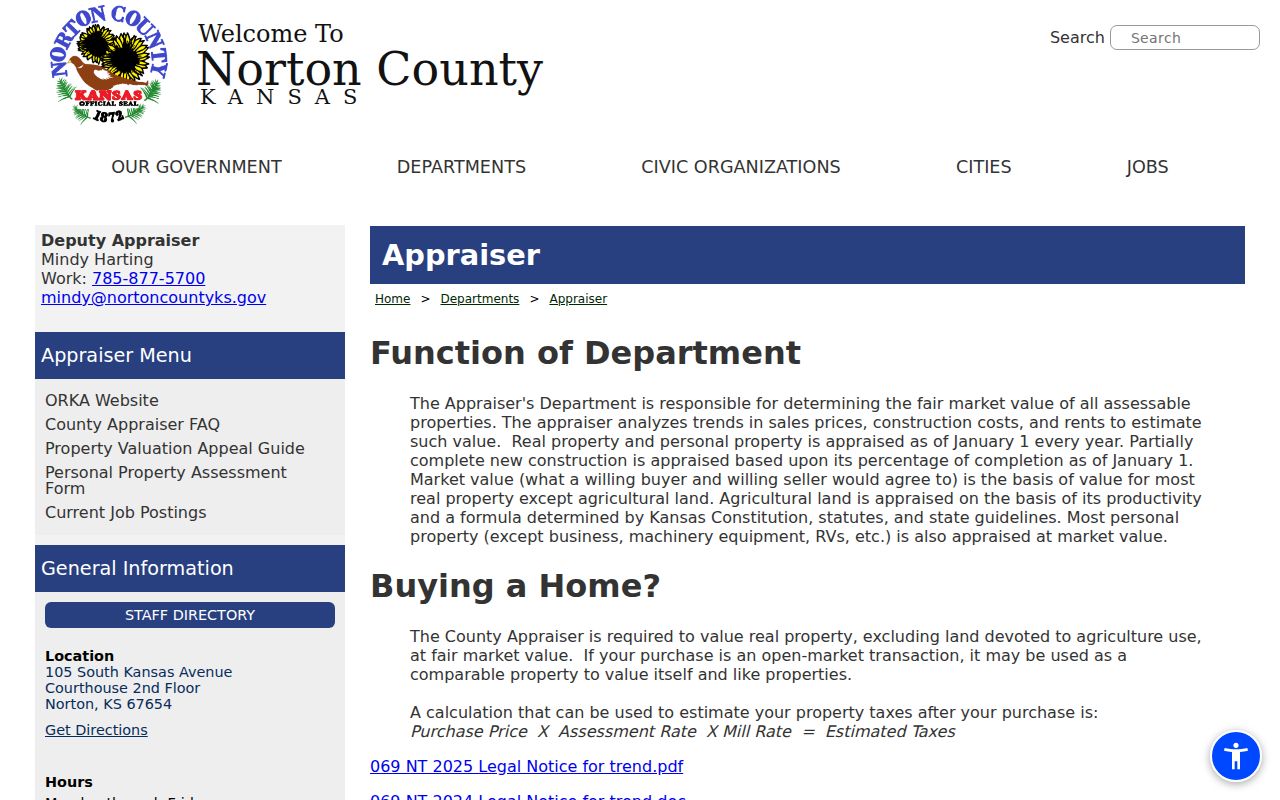
The official page confirms the office route, not any particular owner. Copy the live parcel key, field label, and displayed date exactly as shown.
Norton Roll Dates Need Context
The Appraiser determines value as of January 1, including partly built improvements by completion percentage. That annual point is not a deed recording date. A parcel sold later can still carry data tied to an earlier roll.
No Norton refresh cadence or typical transfer lag was published. State the actual record date and compare it with the newest deed. Do not promise same-day updates.
Norton Mailing and Situs Differ
Situs is the physical land location. The mailing address is where tax correspondence goes, and it may sit elsewhere. Kansas Safe at Home can also give qualifying survivors a substitute legal address. A protected or out-of-area mailing address, in other words, does not mean the owner record itself is wrong.
- Owner of record
- The official roll name at a stated time.
- Assessment roll
- The county classification and value record.
- Situs
- The physical property location.
- Recording lag
- Time between a transfer and its appearance elsewhere.
Entities Hold Norton Property Now
A current owner can be an LLC, corporation, trust, estate, trustee, executor, or joint tenants. Search the exact recorded wording. A trade name may differ from the deed grantee. An estate may name the decedent and the fiduciary in separate records. The Kansas Secretary of State business search adds entity context. But it cannot replace the deed or reveal every beneficial owner. No Norton entity result stands verified here.
Confirm the Current Norton Owner
The assessment roll supplies a present lead. The latest recorded instrument supplies confirmation. Norton County real-estate records sit outside any public online Register index, so the final check requires an office request.
- Find the assessment record by exact address or legal description and capture its year and parcel key.
- Copy the owner name exactly, including entity terms.
- Contact the Register of Deeds with the name, date range, and legal description.
- Compare the newest grantee, recording date, and conveyed land.
- Owner of record
- The party carried on the dated roll.
- Vesting
- The manner in which a deed places title.
- Registered agent
- An entity contact, not necessarily the landowner.
Norton Descriptions Confirm the Tract
City land may use addition, lot, block, fractional lot, or replat. Rural land commonly uses section, township, range, quarter section, or metes and bounds. Spencer's, Howard's, and Hillside additions show the local lot-and-block forms in practice. One notice pairs a commonly known address with fractional lot language. That is why a street address is only a lead, while a complete description keeps same-name owners off the wrong tract.
Court Events Can Delay Clarity
Probate, quiet title, partition, foreclosure, and sheriff-sale cases can explain a shifting trail. Norton District Court offers a free terminal. Fax, mail, and in-person copy routes are also available. Match any order or sale to the later recorded deed. The clerk answers specific requests within three business days and then states cost. A court result may explain a transfer, but it never replaces the conveyance record.
Norton Permits Do Not Prove Ownership
A city building or code record is keyed to an address. It may name an applicant, contractor, complainant, or project contact. None of those roles makes that person the current owner. Norton County has no county zoning. Municipal permit and zoning channels apply inside city limits. A city boundary and postal city name may differ too. Confirm municipal status before asking a city office for records. Use a permit only to understand activity at the situs. Return to the Appraiser and the newest deed for the ownership question.
Use Norton Owner Records Lawfully
A current-owner check cannot reveal every unrecorded claim. It also may miss trust beneficiaries, pending filings, boundary issues, or title defects. Permit records can name an applicant without proving ownership. A map point locates an address but cannot establish title. For the broader address method, see who owns a Norton County property. Contact owners only through lawful published channels, and respect protected addresses.
Check the date. Compare the Norton roll year with the newest deed, and never use owner information to harass or intimidate anyone.
Norton Owners and Tax Mail
The Treasurer and Appraiser both use owner and mailing fields for tax work. A tax-payment name still does not replace the owner of record. A lender, closing agent, relative, or property manager may handle a payment without ever receiving title. Likewise, the destination printed on a tax notice may sit outside Norton County even while the parcel and its current owner stay on the local roll.
When a mailing field conflicts with an expected name, note the tax year. Ask the Appraiser which roll date the display represents. Then compare the grantee on the newest deed. This focused check avoids two common errors. It keeps a correspondence address from being mistaken for the land's situs, and it keeps a payer from being mistaken for the legal owner.
Verify Norton Owner Corrections
Wrong information should go to the office that controls it. In Norton County, that means knowing which office keeps what. The Appraiser handles assessment-roll entries, so parcel and valuation mistakes belong there. The Register of Deeds keeps recorded instruments. It cannot rewrite a deed just because a web result looks off. Bring the address, full legal description, parcel reference, and deed book and page. Note the date you first spotted the problem.
If a supporting file is not posted online, request it under the Kansas Open Records Act. Keep the date range and record type narrow. The agency must respond by the end of the third business day. Otherwise it must explain a delay. That deadline never requires staff to build a fresh ownership report. Any source documents you receive still need comparing at their stated dates.
Some records carry special access limits. Military discharges and Real Estate Sales Validation Questionnaires are two examples. Neither should be expected as routine owner-lookup attachments. A closed supporting document does not make the recorded deed itself private. Ask the Register of Deeds which public index entry and recorded instrument can be supplied. That way you avoid requesting restricted material. Keep the office reply with your search notes.
Estate-held property poses its own timing problem. The newest Norton County tax roll may still show a decedent or fiduciary. Probate and recording steps move forward. Check the District Court case for the order that explains the transfer. Then return to the Register for the deed recorded under that authority. Date every source you rely on. The current-owner conclusion then rests on a clear point in time.