
Compare Norton County Value Types
A value means little without its source. Norton County appraises property for taxation, and that purpose drives one of the numbers. A deed records a transfer and may list sale consideration, while a private appraisal answers a different question entirely.
| Value type | What it means | Where it is recorded |
|---|---|---|
| Assessed value | The class-based amount used in taxation | Appraiser assessment record |
| Market value | The county estimate under its applicable method | Appraiser record and notices |
| Agricultural use value | Productivity or formula value, not a home-sale comparison | Appraiser record |
| Last sale price | Consideration in a specific transfer where public | Recorded deed, not the closed SVQ |
Kansas assessment ratios vary by class. Residential real property is assessed at 11.5 percent of fair market value, commercial property at 25 percent, and agricultural land at 30 percent of agricultural-use value. The class belongs beside every figure. That number is not the sale price.
Norton Values Use January 1
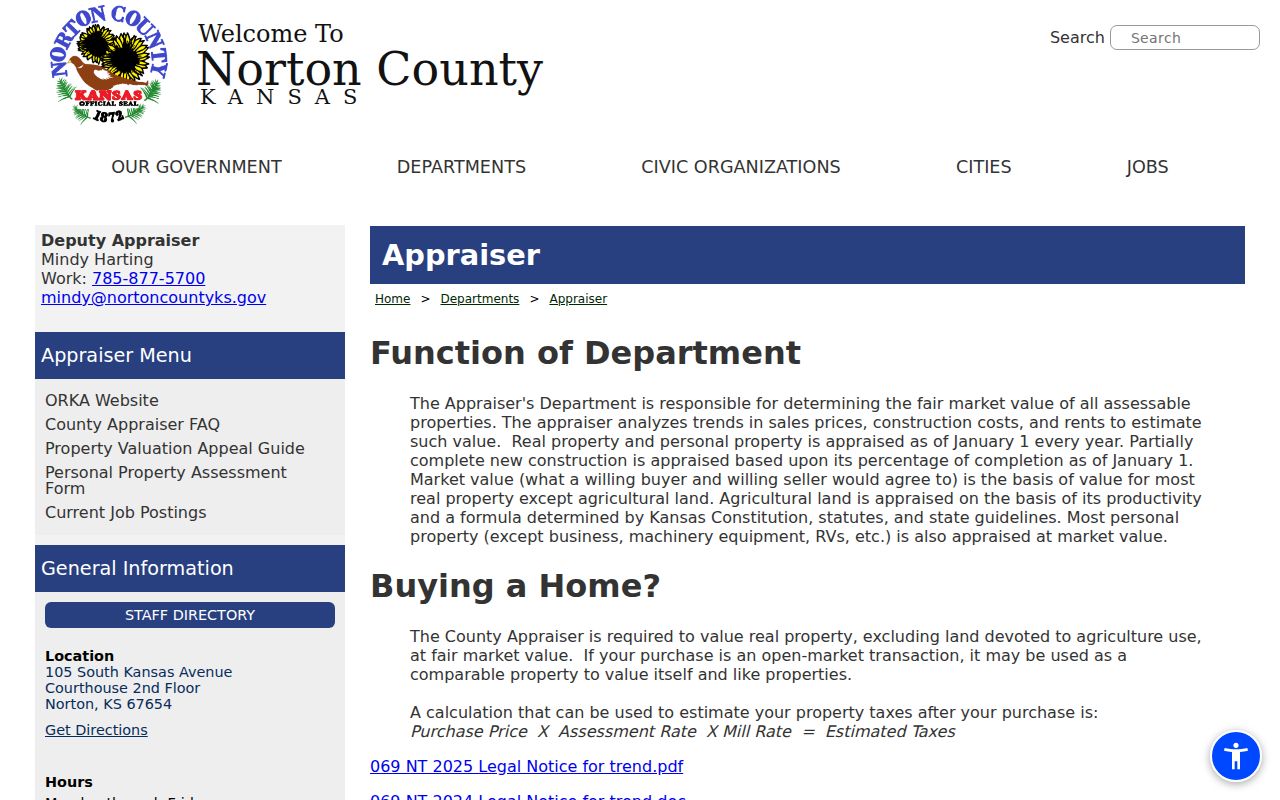
The Norton County Appraiser values assessable property each January 1. Half-built improvements count by percent complete that day. Market analysis leans on sale prices, construction costs, and rents. Farmland follows productivity guidelines instead. The date matters. A later sale or a new improvement cannot be read back. It cannot touch an older valuation year. Always record the assessment year. A property value compared against a deed or a current condition is only sound. Name the valuation year. The Norton County Appraiser page documents the local method and the published notices.
Parcel-specific assessed values require the county's live parcel card.
Norton Agricultural Value Is Different
A farm's agricultural-use value is not a comparable-home estimate. Kansas values qualifying land through productivity formulas. Cropping practice, commodity prices, production costs, and other inputs drive the result. Rural legal descriptions run on section-township-range rather than city additions. Match the right tract and classification before comparing a farm with anything else. Do not compare it with a house, business parcel, or vacant lot. A mixed-use tract may need careful class treatment from the Appraiser. This distinction runs deep in Norton County. Rural records and city lot records there use different description systems. Ignore the class and the figure means little.
Look Up Norton County Assessed Value
ORKA is the Appraiser-linked search start for parcels. Norton County's live card and its value-field labels must be confirmed on the spot before any figure is treated as evidence. A generic Kansas screen proves nothing about Norton's fields.
- Open ORKA from the county route and select Norton County.
- Search the exact address, owner name, county ID, or section-township-range as available.
- Verify the parcel and legal description, then copy each displayed value label, year, and class.
- Ask the Appraiser when a field is missing; do not infer a Norton APN format.
- Compare a sale only after matching the recorded deed to the same tract and date.
Keep the labels intact. Market, assessed, use, land, and improvement figures are not interchangeable just because they sit on one record.
- Assessed value
- The class-based value used in taxation.
- Market value
- The county estimate under its valuation method.
- Assessment ratio
- The statutory percentage applied by class.
- Sale consideration
- The amount tied to a transfer, subject to record limits.
- Reassessment
- A later valuation for a new assessment cycle.
Norton Trend Notices Explain Change
Norton's 2025 valuation-trend notice splits inflation from parcel-specific causes. Corrected descriptions, physical changes, comparable sales, and construction factors can move residential, commercial, and vacant-lot values in different directions. Agricultural values respond to cropping practices, commodity prices, and production costs. The Appraiser page links notices covering 2023 through 2026. Read the notice for the year that matters. Never extend an older statement forward. Countywide trends are not parcel-level facts. Compare the parcel's physical data and legal description from year to year, because a correction can shift a Norton County property value even when the building itself did not.
Norton Sale Records Have Limits
A recorded deed offers a transaction reference. The Real Estate Sales Validation Questionnaire is different. Kansas law restricts its disclosure, and the Norton Register identifies it as closed. It is not a public sale-history source. A price can reflect unusual terms, partial interests, a family transfer, minerals, or land beyond the simple address. Match the legal description and deed language before comparing consideration with assessed value. Execution and recording dates can differ. The Register's real-estate records are not online. A value comparison that needs the deed must go through the office channel with a name, date range, legal description, and any known book or page.
Norton Value Fields Remain Unverified
Norton publishes no official sample parcel card. Separate land, improvement, exemption, sketch, and last-sale fields are therefore not guaranteed. They are not guaranteed anywhere but a live record. If a live card shows them, copy the labels and year. If not, ask the Appraiser rather than borrowing assumptions from another Kansas county. The county's educational estimate multiplies purchase price, assessment rate, and mill rate. It is an illustration, not a bill. Taxing districts and special assessments belong to the tax-roll process. Tax bills, payment channels, exemptions, and appeals belong with the Norton County property tax records. A comparison should stop at meaning and source.
Match Norton Values to Land
Every parcel in Norton carries a legal description, not just a street address. City lots in Norton sit in additions like Spencer's, Howard's, and Hillside. They are identified by lot and block or fractional footage. Rural land works differently. Sections, townships, ranges, quarter sections, and metes and bounds define farm ground outside town. The description matters. It stops a same-name or same-address mix-up from pinning the wrong value on your parcel.
Norton's numbering gives you more clues. Streets count outward from State Street and Main Street under directional and 100-block rules. This helps reconcile an address with the plat. Still, the legal description on the tax roll has to match the parcel. The assessor appraised one specific parcel. ORKA, the statewide search tool, accepts address, owner name, county ID, and section-township-range queries. Field requirements and the result layout vary, so trust what the live screen returns.
Know Norton Property Value Limits
An assessed value has one job: taxation. It will not forecast what a buyer pays. It will not confirm a building's condition. It will not settle a boundary dispute, or stand in for a property-specific appraisal. Dates and purposes shift the figure you see.
Treat the assessment as a public-record comparison point and record its class and year. A deed's sale price marks one historical event. It is not a standing market value for the next tax bill. Agricultural-use value answers a statutory productivity question, not a home-price one. For a sale, an estate, financing, or a contested value, get advice. Get valuation work built for that purpose. Property records are starting evidence, not the final word.
Value versus price. A Norton County assessed value is for taxation. It is neither a promised sale price nor a private appraisal.
Write the valuation date next to every number you copy from a Norton County record. A January 1 assessment and a deed consideration filed later answer different questions. Today's asking price answers a third one. Line them up without their dates and normal timing looks like an error. When a field confuses you, ask the Appraiser. Ask which tax year and classification the displayed value represents.