
Identify a Norton County Owner
Finding who owns a property in Norton County works best when you treat it as a two-step check rather than a single lookup. Start with an exact street address. Match that address to the county assessment record, which names the owner carried on the tax roll. That name is a strong lead, not final proof. The latest recorded deed confirms the transfer itself. Trusts, estates, companies, joint ownership, and an off-site mailing address can all blur the picture. Keep the address, parcel number, legal description, owner of record, and deed date separate as you search Norton County property records.
- Write the exact situs address, including direction, suffix, and city. Try older forms if numbering may have changed.
- Open Kansas ORKA, select Norton County, and try address, name, county ID, or section-township-range.
- Ask the Norton County Appraiser to connect the address or legal description to its assessment record.
- Take the exact name and legal description to the Register of Deeds. Request the newest deed and check its grantee and recording date.
- Resolve any estate, court order, trust, or business name before stating who owns the property.
This flow gives each source its proper role. The map and the Appraiser produce a lead. The recorded deed puts that lead to the test. Neither a label on a plat nor a name at an address proves title.
Norton Appraiser Links Address and Name
The county FAQ routes owner questions to the Appraiser rather than the County Clerk. Bring an address or legal description. The Appraiser values property as of January 1 and links to ORKA, but no official Norton parcel-card sample exposed a verified owner-field label, mailing field, last-sale field, or APN format.
Record the label and date shown in a live result rather than assuming a standard Kansas card. If ORKA does not return a useful Norton entry, call the Appraiser at 785-877-5700 or visit the courthouse second floor during posted weekday hours. Ask for the exact parcel key and legal description with the owner lead.
The official Norton Appraiser page establishes this county route.
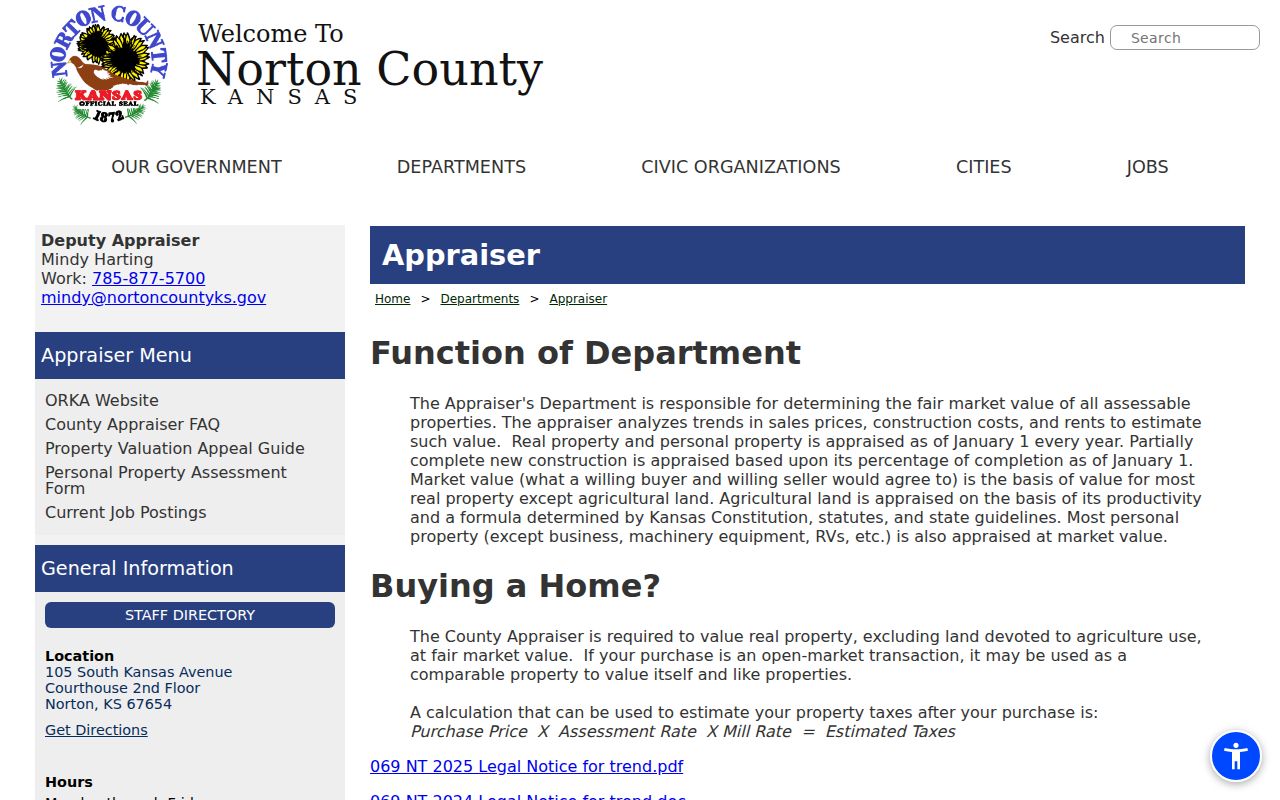
The office page itself displays no parcel owner. Any live appraisal record still needs its own reading.
Confirm Norton County Ownership Offline
The Register of Deeds records deeds, mortgages, easements, surveys, and plats. It also holds water rights, liens, and other instruments. Its county page states plainly that real-estate records are not available online. When you request a search, supply the full grantor or grantee name. Include spelling variants, instrument type, date range, town or addition, lot and block, rural description, and any known book and page. Kansas law requires direct and inverted indexes. That means the deed records can be approached through either party role. Request the newest deed for that matching legal description. Note both the execution date and the recording date. A newly filed transfer often explains why an assessment name differs.
Where Norton County Ownership Appears
Three sources answer different parts of the ownership question. Their dates and purposes must be read together. The assessment record serves a tax year, the deed records a conveyance, and the map ties a location to a parcel or legal-description lead.
| Source | Owner Info It Gives | Access |
|---|---|---|
| Appraiser record | Assessment owner lead and parcel details | Office and ORKA; Norton card fields not captured |
| Register index | Recorded grantor, grantee, instrument, and citation | Office request only |
| ORKA or Norton GIS | Map, address, and parcel context where exposed | Interactive viewer or public REST layers |
| Kansas SOS | Entity identity and filing context | Business Entity Search |
When names disagree, compare the assessment year against the deed recording date and verify the legal description. A gap there settles most mismatches. Where competing instruments, liens, probate interests, or boundary disputes complicate the answer, a title professional may be needed.
Norton Owner Names Need Variants
A property owner may appear as an individual, trustee, trust, limited-liability company, estate, executor, administrator, or joint tenant. Search the exact entity wording plus useful variants. A trade name can differ from the recorded legal entity, and an estate file may list the decedent and the fiduciary separately. Mailing and situs addresses serve different purposes. Situs is the physical land location. A mailing address is where the tax bill goes, and it may sit far off-site. It proves neither residence nor every person with an interest.
- Owner of record
- The name carried by the official roll at its stated date.
- Grantee
- The party receiving an interest under a deed.
- Title
- The legal ownership interest, broader than a portal name.
- Situs address
- The physical property location, distinct from mailing address.
Norton Descriptions Break Owner Ties
Names are broad keys. Legal descriptions attach records to land. Norton city parcels may use an addition, lot, block, footage figure, or a replat, while rural tracts may use section-township-range, quarter sections, or metes and bounds. Preserve the full text rather than shrinking it to a street address. Spencer's, Howard's, and Hillside additions appear in local deed records. The city numbering plan starts from State Street and Main Street under odd, even, and 100-block rules. Those facts explain address variants. Still, the recorded description remains the stronger match.
Protected Kansas Addresses Explain Gaps
Kansas Safe at Home gives qualifying survivors a substitute legal address and mail forwarding. Government agencies generally accept that substitute. A protected mailing address is not a defect in the property record. It is never an invitation to search around the protection. Sales Validation Questionnaires are also closed to ordinary public access. Military discharges carry restricted access. The deed, the assessment record, and a lawful office request remain the proper channels. A private questionnaire is never an owner-search source.
Limit a Norton County Owner Finding
An ownership lookup can identify an assessment name, a recorded grantee, and a tract reference. It cannot prove who occupies the property. It cannot guarantee that no instrument is pending. It cannot resolve every beneficial interest behind a trust or company. It cannot replace a title opinion. A recent deed may postdate the assessment roll. Probate or a court order may explain a transfer.
Lawful use. Norton County owner records support property diligence, estate work, and civic research. Never use them to harass, intimidate, or target anyone.
For the present assessment name and the recent-sale gap, use the Norton County current-owner record. Historical owners require a backward deed chain, not this address-to-owner method.
Norton Ownership Clues Beyond Deeds
Deeds and the assessor roll do not always settle who holds title. Sometimes the answer sits in a courtroom file. Probate records explain why ownership changes hands through an estate. An executor, an heir, or a surviving joint owner can enter the transfer trail in Norton County this way. Quiet-title, partition, foreclosure, and lien cases can reveal the order behind a later conveyance. Search Norton District Court by party name. Then line up the case number, filing date, and legal description before trusting the match. The courthouse terminal is free, printed pages run 25 cents, and certification costs $1 per document. Bigger requests may add a $5 research fee.
A company grantee adds another wrinkle. The Kansas Secretary of State business search separates a registered entity from a mere trade name. That distinction helps when the deed's grantee wording looks generic. It has limits, though. The registry cannot name every person behind a trust. Nor can it prove the entity still owns the parcel today. Treat it as context only. Note the exact roll name first, then try spelling variants. When two entities look nearly identical, compare formation details against the deed's grantee wording instead of grabbing the first match.
Older ownership puzzles call for different tools. The Norton Public Library genealogy room and the Norton County Genealogical Society hold deep collections. Their shelves include newspapers, census microfilm, county histories, cemetery material, and the 1917 Standard Atlas. Those collections can surface forgotten names or place clues tied to a tract. They are leads, not substitutes for the Register of Deeds index. The society charges a $25 first-hour research fee, and library visitors start by signing in at the main desk. Hand the researcher an addition or a rural description, not just a surname.
Before closing the file, run one last identity check. Keep the grantee wording and legal description exactly as recorded. Similar names, trust labels, and business names are never enough to merge two Norton County records. The document date and the tract must agree. Note where each name came from, whether the roll, a deed, a court file, the atlas, or a newspaper. Any later correction can then trace back to its source.