
Trace Norton County Former Owners
Reading Norton County deed records means stepping backward one transfer at a time. Start from a deed you trust. The newest instrument names its grantor and grantee. Then search that grantor as an earlier grantee, match the same legal description in the Norton County property records, and repeat until the chain runs out. A shared surname or street address alone never proves two entries cover the same tract. Cite the book and page before stepping back.
| Transfer date | Grantor to grantee | Instrument | Reference to capture |
|---|---|---|---|
| Newest verified filing | Prior owner to current grantee | Warranty, quitclaim, or other deed | Book/page or document number |
| Earlier acquisition | Earlier grantor to that prior owner | Deed named in the index | Legal description and recording date |
| Estate transition | Estate or fiduciary to successor | Executor or administrator deed | Probate case and deed reference |
| Original land stage | Federal grantor to patentee | Patent or final receiver's receipt | 1874-era finding-aid reference |
The Norton County Register of Deeds keeps the key records. No public online index exists. Staff can search when you supply party names, a tight date range, and the instrument type. You must also give the exact legal description. The county genealogy guide recommends a ten-year window for an ancestor-name search. It also permits searching by legal description alone.
Norton County Records Begin in 1874
Norton County records reach back to 1874. The county's genealogy research finding aid opens its land-record run there. Patents, final receiver's receipts, deeds, and oil and gas leases appear among the early sources. That year is not an online cutoff. Norton County publishes no public web deed index and states no imaging cutover year.
Treat 1874 as a practical starting point. It is not proof of an unbroken entry for every tract. Norton County was established in 1867. It was organized in 1872, so federal and territorial land sources may predate the local run. Ask the Register which books or microfilm cover your period. The library and genealogical society hold further finding aids for Norton County property records.
Offline record depth. The known finding aid begins in 1874, but no online grantor-grantee coverage exists or has a published cutoff.
Reconstruct Norton County Ownership Backward
One index direction sorts grantors. The other sorts grantees. Kansas law requires both, and Norton County ownership history needs both because past owners swap roles across transactions, so capture the full citation before stepping back another step.
- Identify the latest deed tied to the correct Norton County legal description, with its recording date and book/page or document reference.
- Read the grantor on that deed. That party is the prior owner for this transfer, though the deed's estate language still controls what interest moved.
- Search that prior owner as a grantee within the likely acquisition period. Match addition, lot and block, or section-township-range.
- Repeat the process, noting quitclaims, life estates, joint tenancies, probate orders, releases, and name variants that affect the chain.
- When county books reach the federal-land stage, use the patent or receiver's receipt and keep that citation with the local chain.
An index entry only points to an instrument. Read the deed itself. A grantor may transfer just a fractional interest, mineral right, easement, or life estate, so state past ownership no more broadly than the recorded language supports.
- Grantor
- The party conveying an interest.
- Grantee
- The party receiving the interest.
- Chain of title
- The linked sequence of instruments affecting one tract.
- Reverse index
- The grantee-oriented, or inverted, route through the register.
- Quitclaim deed
- A transfer of whatever interest the grantor has, without the warranties of a warranty deed.
Norton Plats Keep Old Tracts Stable
Street names and house numbers change. A platted legal description follows the land instead. Norton City Code keeps the master plat with the City Clerk and ties numbering to State Street, Main Street, odd and even sides, and 100-block increments. Those rules help, but they never identify a parcel.
Local Norton County records show the description patterns. Spencer's Addition appears as lots and a block in a historic property record. Howard's Addition appears in a 2024 sheriff-sale notice. A 2026 Hillside Addition notice pairs a common street address with fractional lot-and-block language. Search each addition name exactly, and preserve any replat, vacation, or fraction.
Rural chains use a different key. Section, township, range, quarter section, and metes and bounds replace addition and block references. A postal city or nearby road is only a locator; the deed description remains the link among former owners in Norton County property records.
Norton Refilings Explain Name Changes
Norton was laid out by 1873. Rogers' plat was recorded on December 7, 1878, a Norton Town Association filing followed later that month, and another refiling came in 1886. Roughly two dozen additions eventually formed the city. That history explains why one previous owner's tract may appear under shifting townsite or addition terms in Norton County property records.
The county itself was briefly named Billings in 1873. Norton returned the next year. Contemporary newspapers and administrative records can therefore use a place name a modern searcher would never guess. This history is a search aid, not proof a deed is missing. Search both names in early Norton County records.
Historic Sources Test Deed Clues
The 1917 Standard Atlas of Norton County pairs landowner maps with city maps and can place a family name on the ground at one point in time. It puts a name in a place. That helps between deed citations. An atlas is still a snapshot, though, not current title and no substitute for the deed records held by the register.
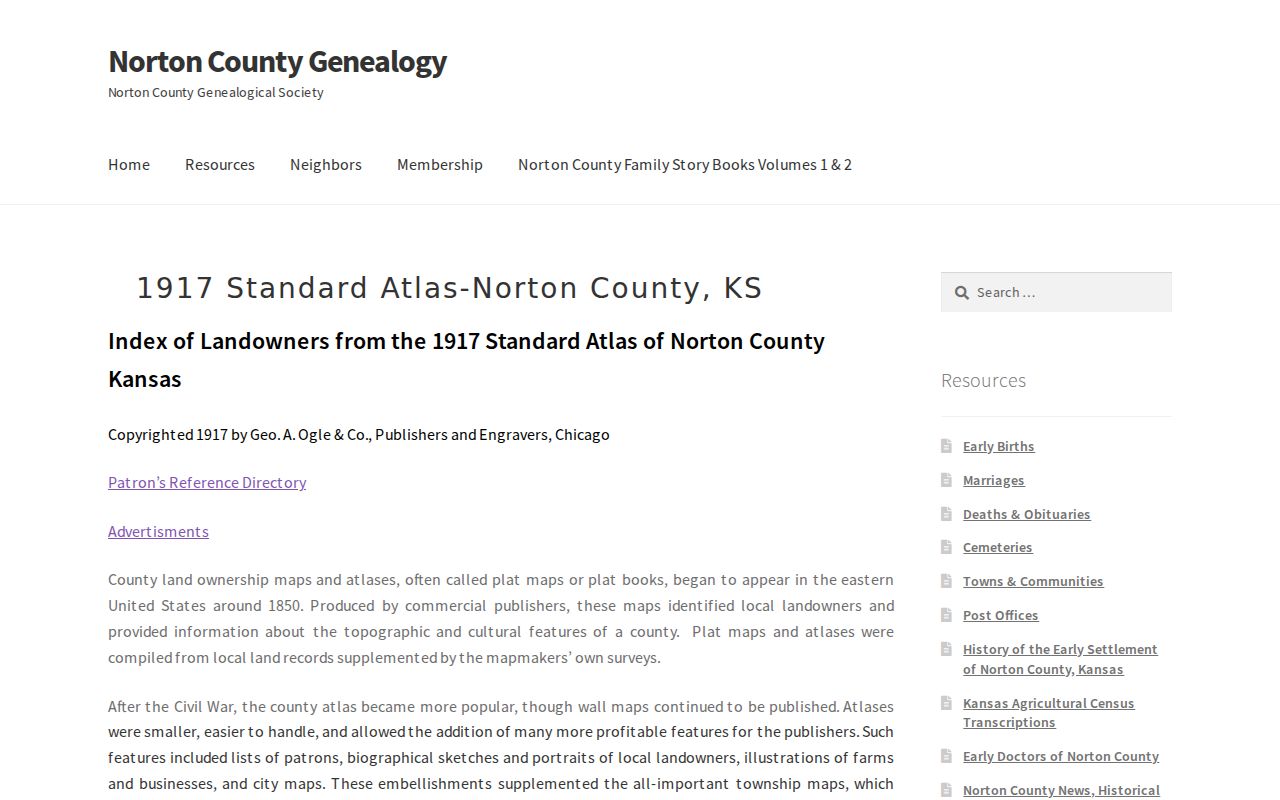
A landowner map is only a lead. Match the legal description first. Carry the atlas name back to the deed books. Confirm the same tract before it joins a Norton County ownership chain.
The Kansas Historical Society newspaper catalog adds sale notices, probate notices, obituaries, and local name variants. So do the Norton Public Library and the Norton County Genealogical Society. The society lists the Norton County News from 1870 through 1916. Newsprint can hint at a deed date. An estate notice narrows the hunt. But the recorded instrument in the Norton County deed records supplies the actual transfer.
Probate Can Bridge Previous Owners
A clean chain of title sometimes stops at a death. Norton County deeds can also pause when an owner held land jointly. A pause can also come from a life estate. Some owners signed title over through an executor. Norton District Court keeps the probate records. Its case files may hold a will, an inventory, an order, or a property-division document. Those papers explain the next deed. It may name an estate, fiduciary, heir, or surviving joint tenant.
The District Court Clerk offers a free public terminal. Copy requests go by fax, mail, or in person. Bring a case number if you have one. Printed copies run twenty-five cents per page. Larger requests can carry research charges. The clerk reports responses within three business days, plus a fee for certification. Tie any probate finding back to the recorded deed that follows it.
Verify Norton County Prior Owners
A name lead only becomes a land-record conclusion with a full trail. Confirm each prior owner against the same tract. Read the interest each deed actually conveyed. Then watch for later corrections or releases. Norton County suffered no courthouse fire, flood, or countywide record loss. So do not explain a gap with an invented disaster. Instead, ask the custodian which book, film, or index covers the missing period.
You can request register research at the courthouse. You can also do it by phone, email, or mail through the office's published contacts. The county genealogy guide quotes eighteen dollars per hour paid in advance. It also quotes one dollar per copy page. The county's older fee sheet and the current Kansas recording statute disagree with those figures. Confirm the present charge before sending any payment. For a copy of a single instrument, the Norton County deed records page spells out that request.
Lawful use. Former-owner research supports house history, estate work, and property diligence. It must never be used to track, target, or harass a living person.